

Are you tired of watching your hard-earned cash sit in a traditional savings account, earning next to nothing? For many of us, the bank account feels like the safest place to store money. However, if your funds are just sitting in a basic account with a minimal interest rate of 1% to 3%, inflation is quietly eating away at your purchasing power every single day.
The good news? You don’t have to take wild risks in the stock market to make your money grow. There are several clever, low-risk, and smart strategies you can implement right inside your existing banking relationship to turn your idle cash into a growing asset.
In this comprehensive guide, we will break down actionable, proven ways to grow your money in the bank effectively.
Table of Contents
Toggle1. Upgrade to a High-Yield Savings Account (HYSA)
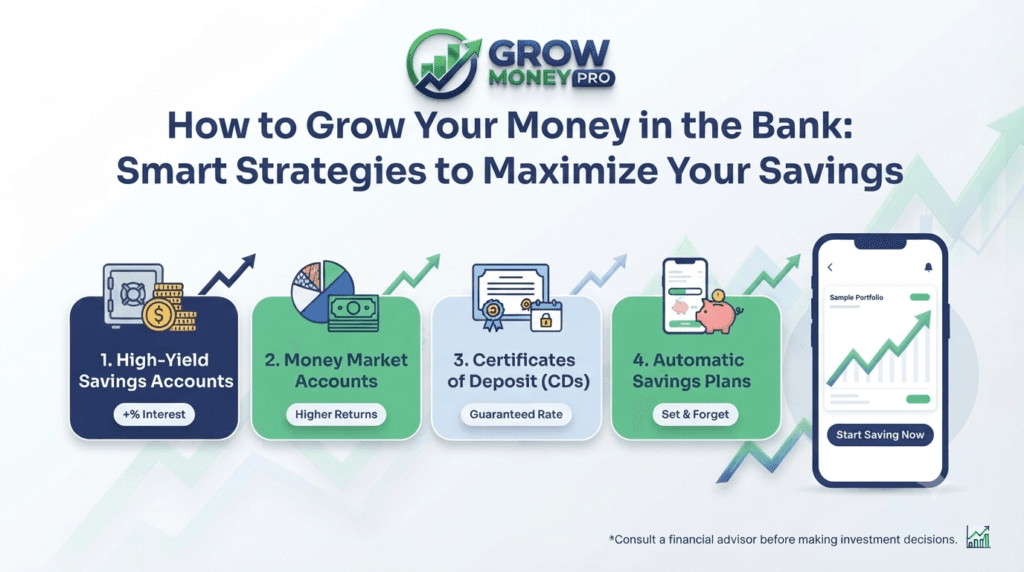
The easiest and most passive way to boost your bank earnings is by moving your cash from a traditional savings account to a High-Yield Savings Account.
- How it works: HYSAs are typically offered by online banks or digital-first financial institutions that operate with lower overhead costs. Because of this, they pass on higher interest rates to their customers—often multiplying your earnings significantly compared to standard brick-and-mortar banks.
- Why do it: Your money remains completely liquid and accessible for emergencies, but it earns significantly higher interest just by sitting in the account.
2. Leverage Fixed Deposits (FDs) for Guaranteed Returns
If you have a lump sum of money that you won’t need in the immediate future, locking it away in a Fixed Deposit is a time-tested strategy for safe wealth accumulation.
- How it works: You deposit a specific amount of money for a predetermined period (ranging from a few months to several years) at a fixed interest rate agreed upon at the time of booking.
- Why do it: FDs offer complete capital protection. Unlike market-linked investments, your returns are guaranteed regardless of stock market volatility. Additionally, many institutions offer preferential interest rates to senior citizens, making it an excellent tool for risk-averse savers.
3. Automate Growth with Recurring Deposits (RDs)
Building wealth is a habit, not a one-time event. If you find it difficult to save a large lump sum all at once, Recurring Deposits provide a structured solution.
- How it works: You commit to saving a fixed amount of money every single month into a dedicated RD account. The bank pays you fixed-deposit-tier interest rates on your cumulative monthly savings.
- Why do it: It instills strict financial discipline. By automating a monthly transfer from your primary account to your RD, you “pay yourself first” before you get a chance to spend that money on non-essentials.
4. Utilize “Sweep-In” and “Sweep-Out” Facilities
Many modern bank accounts offer a feature called a sweep-in facility, which bridges the gap between high liquidity and high returns.
- How it works: You set a threshold limit for your primary savings account (e.g., any surplus cash over $2,000 or ₹25,000). Automatically, any funds above that limit are “swept” into a higher-yielding fixed deposit or liquid account.
- Why do it: If you ever make a transaction or write a check that exceeds your main balance, the bank automatically sweeps the required money back from your FD (“sweep-out”) instantly without heavy penalties, ensuring your money works hard all the time.
5. Explore Linked Liquid Mutual Funds
If you want to stretch your bank account’s financial utility further, look into digital banking apps or partner investment platforms linked to your account.
- How it works: These services route your idle capital into short-term liquid mutual funds that invest in high-grade money market instruments.
- Why do it: Liquid funds often yield slightly higher returns than standard savings accounts while offering rapid or instant redemption features directly back to your bank account when needed.
Summary Checklist to Maximize Bank Growth
- Audit your current account: Find out what your current interest rate is and compare it with market leaders.
- Keep an emergency fund liquid: Maintain 3 to 6 months of living expenses in an accessible high-yield account.
- Lock in excess cash: Utilize FDs or RDs for intermediate financial goals.
- Automate your savings: Set up auto-debits so you don’t rely entirely on willpower.
By implementing even two or three of these smart strategies, you can transform your bank account from a simple storage box into a reliable, low-risk engine for financial growth.