

Table of Contents
ToggleIntroduction: Why You Should Start Investing Today
Learning how to start investing in the stock market is one of the most critical financial milestones you can achieve in your lifetime. If you keep all your hard-earned savings sitting idle in a basic savings account, inflation is quietly eroding your purchasing power year after year. Prices of everyday goods, education, healthcare, and housing continue to rise, meaning your money needs to grow at a faster pace just to maintain your current lifestyle.
Investing in equities remains one of the most proven, reliable methods to build long-term wealth, outpace inflation, and ultimately reach financial independence. While the global financial world often sounds intimidating—filled with complex jargon, blinking trading terminals, and daily news alerts about sudden market crashes—getting started is far simpler than most people realize. You do not need a background in economics, a massive inheritance, or lakhs of rupees to take your first steps. This comprehensive guide breaks down the essential steps every absolute beginner needs to take to enter the stock market safely, intelligently, and with confidence. If you want to expand your financial knowledge further, you can also explore our detailed guide on Mutual Funds Guide.
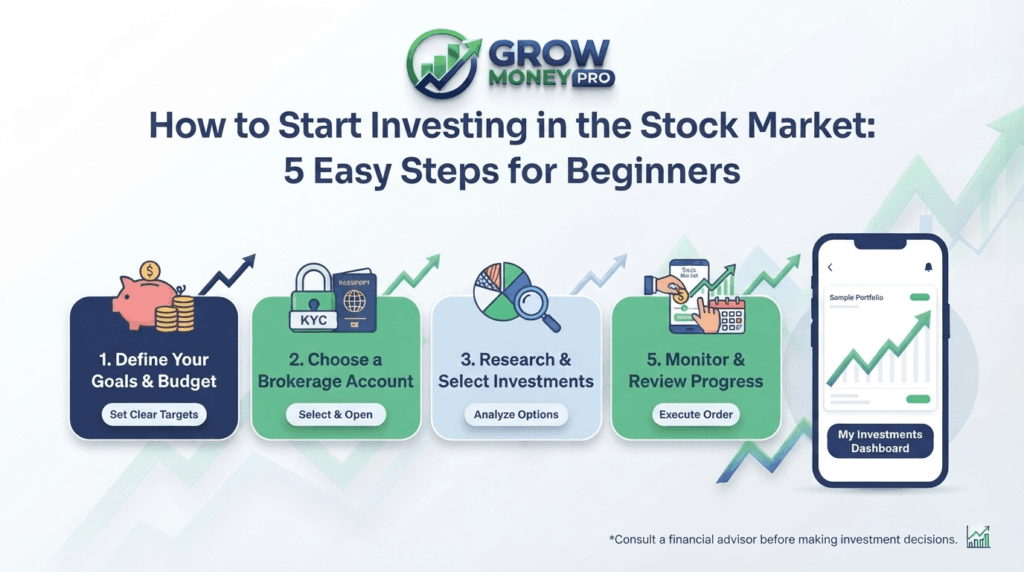
Step 1: Define Your Financial Goals, Timeline, and Risk Tolerance
Before you transfer a single rupee or dollar into a brokerage account, you must step back and map out your financial destination. If you are a beginner looking to understand how to start investing in the stock market, you must first ask yourself: Why are you investing? How long can you stay invested? And how much market turbulence can you handle without losing your peace of mind?
- Short-Term Goals (1 to 3 years): If you are saving for an upcoming vacation, a wedding, a vehicle down payment, or building your foundational emergency reserve, the stock market is generally too volatile for short-term needs. Capital preservation takes priority over growth here.
- Long-Term Goals (5+ years): Building a robust retirement corpus, funding your children’s higher education, or securing generational wealth. This is where stock market investing truly excels, giving your money the time it needs to compound and ride out short-term economic cycles.
- Assessing Your Risk Tolerance: Every investor has a different psychological threshold. Ask yourself honestly: how would you react if your overall investment portfolio dipped by 15% or 20% in a single volatile month? If a temporary market drop causes you severe panic and sleepless nights, you will want to build a much more conservative, balanced asset allocation mix right from the start.
Step 2: Build Your Financial Safety Net First
A common mistake made by new investors is deploying every single rupee into stocks without keeping any safety cushions. Before you buy your first share, ensure you have established two non-negotiable financial pillars:
- The Emergency Fund: Set aside at least 3 to 6 months’ worth of essential living expenses (rent, groceries, utility bills, and loan obligations) in a high-interest savings account or liquid mutual fund. This ensures you are never forced to sell your long-term stock investments prematurely during a personal financial crunch or job loss.
- Adequate Insurance Coverage: Protect yourself and your dependents with proper health insurance and term life insurance policies. Medical emergencies can wipe out years of stock market gains overnight if you are completely uninsured.
Step 3: How to Start Investing in the Stock Market via Demat Account
To buy shares, exchange-traded funds (ETFs), or mutual funds in the modern digital era, you cannot purchase them directly from a company; you need a bridge to the stock exchanges (like the National Stock Exchange of India). If you want to know how to start investing in the stock market, following a disciplined approach is essential, and setting up the right accounts is your first practical move. This bridge consists of three interconnected accounts:
- Savings Bank Account: The traditional bank account where your active income lands.
- Trading Account: The online portal or software interface provided by a broker that allows you to place buy and sell orders in the live market.
- Demat Account (Dematerialized Account): This acts as a digital locker where your purchased shares and securities are held safely in an electronic format, monitored by depositories like CDSL or NSDL.
- Choosing a Broker: Modern discount stockbrokers (such as Zerodha, Groww, Upstox, or Angel One) offer a completely paperless, fast onboarding process, zero brokerage fees for long-term equity delivery, and highly intuitive mobile apps tailored specifically for retail beginners.
Step 4: Choose Your Core Investment Strategy and Asset Mix
You do not need to hunt for multi-bagger penny stocks or try to time market peaks to build a successful portfolio. In fact, most everyday investors achieve steadier, stress-free long-term results by sticking to time-tested core strategies:
- Investing in Blue-Chip Companies: Focus your initial capital on well-established industry leaders—businesses with strong balance sheets, clean corporate governance, low debt-to-equity ratios, and decades of steady revenue growth.
- Leveraging Mutual Funds and Index Funds: If picking individual stocks feels overwhelming or time-consuming, you can invest in professionally managed mutual funds or low-cost index funds (like Nifty 50 index funds). These instruments automatically diversify your money across dozens or hundreds of top-tier companies.
- The Power of SIP (Systematic Investment Plan): Instead of dumping a lump sum all at once, use an automated SIP to invest a fixed amount every single month. This habit eliminates emotional decision-making and leverages Rupee Cost Averaging, automatically buying more units when markets are low and fewer units when prices are high.
Stock Investment Growth Tracking Chart
To visualize how small, consistent monthly investments compound over time through disciplined saving, examine the simulated growth trajectory outlined in the tracking table below:
| Months of Investing | Monthly Investment Amount | Expected Annual Growth Rate | Total Corpus Built (Approx.) |
|---|---|---|---|
| Month 6 | ₹5,000 | 12% p.a. | ₹30,900 |
| Month 12 (1 Year) | ₹5,000 | 12% p.a. | ₹63,500 |
| Month 36 (3 Years) | ₹5,000 | 12% p.a. | ₹2.05 Lakhs |
| Month 60 (5 Years) | ₹5,000 | 12% p.a. | ₹3.82 Lakhs |
(Note: Consistency, discipline, and the mathematical magic of compounding transform small regular monthly allocations into substantial financial assets over multi-year horizons).
Step 5: Avoid Common Beginner Traps and Mistakes
Entering the stock market without awareness can expose you to avoidable financial pitfalls. If you are learning how to start investing in the stock market, you must keep these core rules in mind:
Never Follow Blind Social Media Tips: Avoid buying stocks simply because an anonymous influencer or a random social media group recommended them. Always perform basic due diligence or stick to diversified funds.
Do Not Panic Sell During Corrections: Market pullbacks, corrections, and temporary crashes are completely normal parts of economic cycles. Selling your quality holdings during a market dip locks in permanent losses instead of allowing your investments time to recover and thrive.
Avoid Leverage and Intraday Trading Early On: Intraday trading, futures, and options (F&O) require advanced technical mastery and high risk appetite. Beginners should stay strictly away from speculative leverage and focus entirely on long-term cash delivery investing.
Frequently Asked Questions (FAQs)
Q1: How much minimum money do I need to start investing in the stock market? A: You can start with a very small budget—even ₹100 or ₹500 through mutual funds or affordable fractional and retail equity shares.
Q2: Is the stock market inherently risky for absolute beginners? A: All market-linked investments carry a degree of financial risk, but you can mitigate it drastically by maintaining a long-term horizon, avoiding borrowed money or leverage, and diversifying your holdings.
Q3: Do I need to sit and track stock price charts every single day? A: Absolutely not. In fact, if you are a long-term investor or mutual fund SIP contributor, checking your portfolio daily often triggers unnecessary psychological stress and poor emotional choices. Checking your investments once a month or on a quarterly basis is more than sufficient.
Conclusion
Taking your first steps into the stock market can feel daunting at first glance, but if you are wondering how to start investing in the stock market, taking small steps today will secure your financial future. If you want to know how to start investing in the stock market, the single biggest financial risk you can take over your lifetime is not investing at all while inflation silently eats away at your hard-earned cash. Take it one structured step at a time, set up your digital accounts, prioritize continuous learning, and give time the opportunity to work its compounding magic on your wealth.



Pingback: Market Update Today: Sensex Slides 417 Pts and Nifty Falls
Pingback: Share Market Crash Today: Sensex Drops 220 Pts