

Table of Contents
ToggleImportant Note & Disclaimer
Disclaimer: This guide is for educational and informational purposes only. Tax laws, slabs, and deduction limits are subject to amendments under the Union Budget and Income Tax Act. Please consult a Chartered Accountant (CA) or a certified tax advisor before filing your tax returns or executing tax-saving investments.
Introduction: Keeping More of What You Earn
When it comes to financial planning, exploring Top Tax-Saving Options in India is one of the most effective ways to lower your annual tax liability and grow your wealth. Taxes are a vital contributor to the nation’s public infrastructure and economic development, but paying more than your fair share due to a lack of structured financial planning is entirely avoidable. Whether you are carefully navigating the traditional deductions of the Old Tax Regime or utilizing the simplified tax-slab frameworks and rebates of the New Tax Regime, proactive tax management is a cornerstone of sound personal finance.
If you have already established a disciplined Monthly Budgeting & Saving Guide, built a secure Emergency Fund Guide, mastered long-term wealth growth through Mutual Funds vs Direct Stocks, and learned how to avoid Common Financial Mistakes, optimizing your tax liability is the next essential phase toward complete financial efficiency. Utilizing Top Tax-Saving Options in India ensures that your hard-earned money remains invested in your own future rather than going entirely toward taxes.
The Tax Regime Landscape: Old vs. New Frameworks
Before committing capital to specific tax-saving instruments under any of the Top Tax-Saving Options in India, you must evaluate which of the two active tax regimes aligns best with your income structure and financial commitments:
- The Old Tax Regime: Retains the familiar array of deductions, exemptions, and allowances—such as Section 80C, Section 80D, Section 24(b) (home loan interest), and House Rent Allowance (HRA). This regime continues to benefit individuals with heavy long-term commitments like home loans, children’s tuition fees, or traditional insurance policies.
- The New Tax Regime: Serves as the default tax structure for individuals, featuring progressive tax slabs and a higher tax rebate threshold. Under current guidelines, resident individuals with a taxable income of up to ₹12 Lakh effectively pay zero tax due to enhanced Section 87A rebates, and salaried individuals enjoy a ₹75,000 standard deduction (making income up to ₹12.75 Lakh tax-free under this framework). However, most traditional deductions are stripped away in this regime.
Top Tax-Saving Options in India Under Section 80C (Old Regime)
If you opt for the Old Tax Regime to lower your taxable income, Section 80C allows you to deduct up to ₹1.5 Lakh per financial year from your gross total income. Implementing the right Top Tax-Saving Options in India within this section creates a solid foundation for your savings:
1. Equity Linked Savings Schemes (ELSS)
ELSS mutual funds are diversified equity growth schemes that come with a statutory lock-in period of 3 years—the shortest lock-in among all traditional 80C options.
- Why Choose It: Beyond securing tax deductions, exploring Top Tax-Saving Options in India like ELSS exposes your capital to top-tier equity markets, offering robust inflation-beating wealth compounding over a medium-to-long-term horizon. For more details on fund selection, you can refer back to our comprehensive Mutual Funds vs Direct Stocks guide.
2. Public Provident Fund (PPF)
Backed by the Government of India, PPF is a secure 15-year debt instrument offering attractive interest rates backed by EEE (Exempt-Exempt-Exempt) tax status (meaning your contributions, accumulated interest, and final maturity proceeds are entirely tax-free).
- Why Choose It: It provides absolute capital safety, making it a stellar bedrock for your fixed-income portfolio allocation.
3. National Pension System (NPS) Tier-1
In addition to the standard Section 80C cap, Section 80CCD(1B) provides an exclusive additional deduction of up to ₹50,000 per financial year for voluntary contributions made to an NPS Tier-1 account.
- Why Choose It: It synergizes long-term retirement planning with immediate tax savings, channeling funds into a diversified mix of equity, corporate debt, and government securities.
4. Life Insurance Premiums and Children’s Tuition Fees
- Term Insurance: Premium payments toward a pure Health vs Term Insurance protection plan qualify for deductions under Section 80C while securing your dependents against unforeseen tragedies.
- Tuition Fees: Full-time tuition fees paid to any recognized school, college, or university in India for up to two children can be claimed under 80C.
Essential Deductions Beyond Section 80C
To further optimize your taxable income under the Old Tax Regime, look beyond 80C to capture additional statutory deductions:
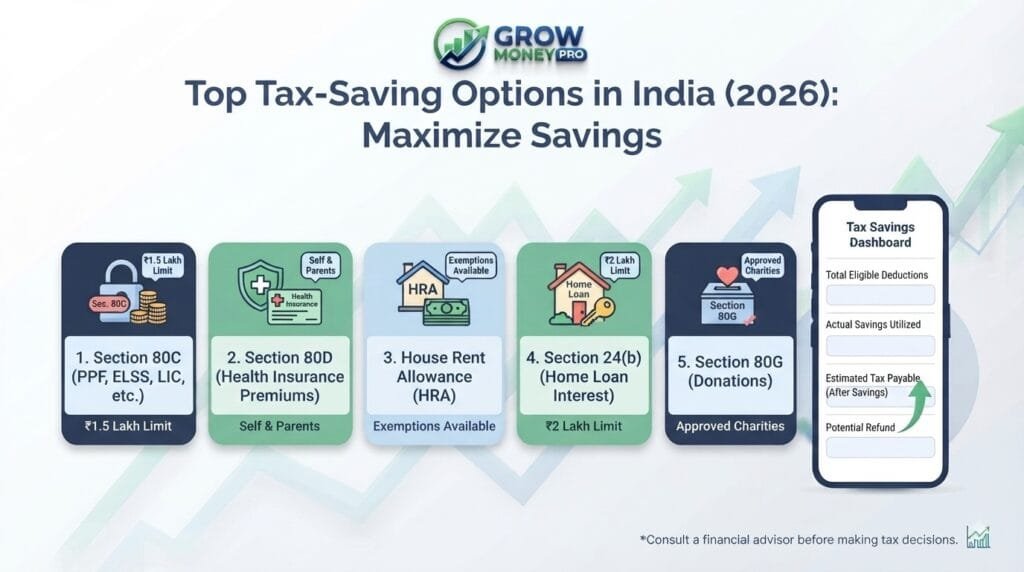
- Section 80D (Health Insurance): Claim deductions up to ₹25,000 for health insurance premiums paid for yourself, your spouse, and dependent children (with an additional ₹50,000 deduction available if premiums cover senior citizen parents).
- Section 24(b) (Home Loan Interest): Claim up to ₹2 Lakhs per financial year on the interest portion paid toward a self-occupied residential property loan.
Strategic Financial Planning and Smart Execution
Successfully leveraging Top Tax-Saving Options in India requires strategic planning rather than hurried last-minute actions. Many taxpayers commit the error of investing large sums in March just to save tax, which often leads to poor financial products and misallocated capital. To manage your cash flows better throughout the year, make sure to follow the strategies outlined in our Monthly Budgeting & Saving Guide. Spreading your investments through Systematic Investment Plans (SIPs) ensures better Rupee Cost Averaging and lowers financial stress. Furthermore, maintaining a diverse portfolio balancing equity instruments like ELSS with fixed-income instruments like PPF and NPS provides a balanced risk-reward ratio suited to your long-term goals.
Frequently Asked Questions (FAQ)
1. Should I choose the Old Tax Regime or the New Tax Regime? Your choice depends entirely on your total deductions. If your combined deductions across 80C, 80D, HRA, and home loan interest exceed ₹2.5 to ₹3.5 Lakhs annually, the Old Regime is typically more beneficial. If you prefer minimal paperwork and have fewer traditional deductions, the New Tax Regime offers lower slab rates and a simpler filing process.
2. When is the ideal time to execute tax-saving investments? Always spread your Top Tax-Saving Options in India across the financial year (starting in April or May) via monthly SIPs. Last-minute investments rushed through in March often result in poor financial choices and misallocated capital.
3. Are capital gains from tax-saving ELSS funds taxable? Yes. Long-Term Capital Gains (LTCG) exceeding ₹1.25 Lakh per financial year from equity-oriented mutual funds and ELSS are taxed at 12.5%.
External Resources & Official Portals
- File your income tax returns, track tax refunds, and check official updates securely on the Official Income Tax Department of India Portal.
- Review market regulations, compliance frameworks, and investor guidelines on the Securities and Exchange Board of India (SEBI) Portal.