

Table of Contents
ToggleImportant Note & Disclaimer
Disclaimer: This comprehensive guide is for educational and informational purposes only. Personal finance strategies, tax rules, and investment returns vary based on individual circumstances. Please consult a SEBI-registered financial advisor or a certified tax professional before making major financial commitments.
Introduction: Why Personal Financial Planning is Your Ultimate Life Skill
Money touches almost every single aspect of our lives. Yet, surprisingly, financial literacy is rarely taught in traditional schools or colleges. Many young professionals start earning well, but due to a lack of a structured financial blueprint, their hard-earned money either sits idle in low-interest savings accounts or gets washed away by lifestyle inflation and high taxes.
Effective personal financial planning is not just about hoarding cash or living a life of extreme deprivation. True financial planning is the art of aligning your hard-earned income with your life goals, protecting your family against unexpected emergencies, minimizing your tax outflow legally, and making your money work for you 24/7.
When you begin your journey of personal financial planning, you take complete control of your financial destiny. Whether you are trying to understand the nuances of the Old vs New Tax Regime: Best Calculator & Guide (2026), figuring out How to Plan Your Monthly Budget & Save ₹10,000 Every Month, or learning How to Build an Emergency Fund in India, mastering the core pillars of personal finance is your first step toward absolute peace of mind. Let’s dive deep into the ultimate framework for managing your wealth in 2026 through strategic personal financial planning.
Pillar 1: Mastering Your Cash Flow & Monthly Budgeting
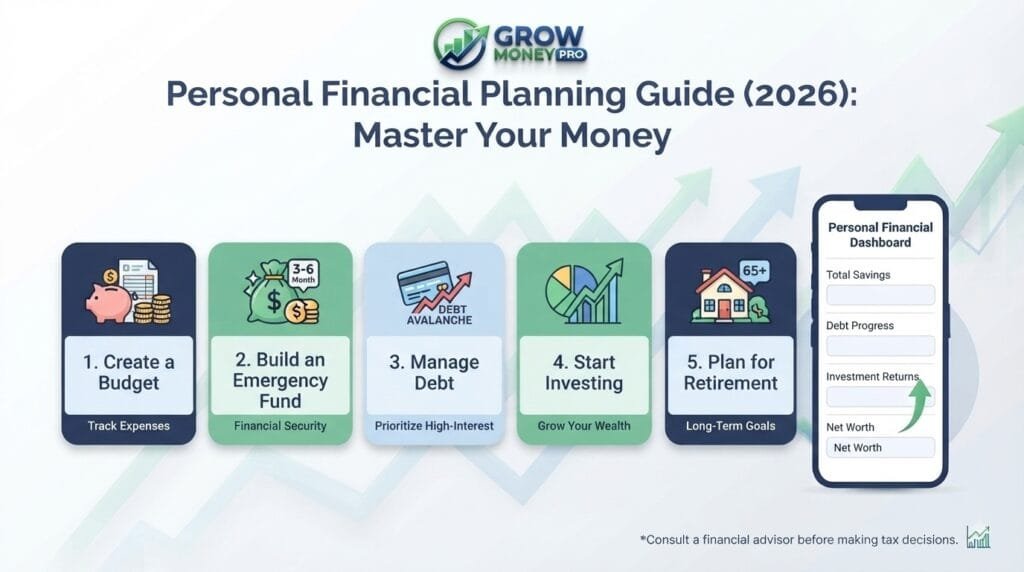
Before you can think about investing in the stock market or buying real estate, you must master the foundation of personal finance: your monthly cash flow. If money flows out of your account faster than it comes in, no investment strategy can save you.
Solid personal financial planning always starts with a well-structured monthly budget. To learn more about setting up your basic financial tracking, check out our guide on Monthly Budgeting Basics.
The 50-30-20 Rule Explained
One of the most robust, time-tested methods for managing monthly income via proper personal financial planning is the 50-30-20 rule. By splitting your net take-home salary into three distinct buckets, you eliminate guesswork:
- 50% for Needs: This covers non-negotiable living expenses such as house rent, grocery shopping, electricity and utility bills, internet charges, essential commuting costs, and minimum loan EMIs.
- 30% for Wants: This handles your lifestyle choices, comfort, and entertainment—such as dining out at restaurants, weekend trips, ordering food online via delivery apps, shopping for clothes, and OTT streaming subscriptions.
- 20% for Savings & Investments: This is your wealth-building engine. It goes straight into building emergency reserves, mutual fund SIPs, retirement funds, and prepaying high-interest debt.
Practical Steps to Save ₹10,000 Every Month
If saving a chunk of your income feels challenging, implement these granular adjustments as part of your personal financial planning:
- Adopt “Pay Yourself First”: On the exact day your salary hits your account, automatically transfer your target savings amount into a separate investment or savings account before you start spending.
- Audit Recurring Subscriptions: Review your digital subscriptions. Do you really need four different streaming platforms active at the same time? Trimming unutilized apps can instantly save you ₹500 to ₹1,000 monthly.
- Smart Grocery and Dining Habits: Cutting down random online food orders from 8 times a month to 2 times can single-handedly save you over ₹2,000 every month without degrading your quality of life.
Pillar 2: Building Your Financial Fortress (Emergency Funds & Insurance)
A common mistake beginners make is jumping straight into aggressive stock trading or volatile crypto assets without building a safety net. Life is unpredictable, and emergencies do not knock before arriving. Proper personal financial planning dictates that safety always comes before growth.
Why You Need 3 to 6 Months of Expenses
An emergency fund is a pool of liquid cash kept strictly aside for unforeseen events like sudden job loss, urgent medical procedures, or unexpected family crises.
- Calculate your non-negotiable monthly expenses (rent, groceries, basic utilities).
- Multiply that number by 3 to 6. If your monthly essential expenses total ₹35,000, your target emergency fund should sit safely between ₹1,05,000 and ₹2,10,000.
- Park this money in high-yield digital savings accounts, liquid mutual funds, or sweep-in fixed deposits that offer instant liquidity. Never lock your emergency corpus in long-term locked assets like real estate or equity stocks. For detailed steps, read our guide on Emergency Funds Planning.
The Critical Role of Insurance
Insurance is not an investment; it is protection against financial ruin. Every earning individual must look into two primary covers during their personal financial planning journey:
- Term Life Insurance: If you have financial dependents (parents, spouse, children), get a term insurance policy with a cover worth at least 10 to 15 times your annual income. Keep the premiums affordable by buying it early in life.
- Health Insurance: Do not rely solely on corporate group health insurance. Buy an independent family floater health insurance policy to cover major hospitalizations, protecting your hard-earned savings from medical inflation.
Pillar 3: Smart Tax Planning to Maximize Your Take-Home Income
Taxes can quietly erode a massive chunk of your lifetime earnings if you do not plan proactively. In India, understanding how to navigate tax regimes is crucial for maximizing net annual wealth through effective personal financial planning.
Old Tax Regime vs. New Tax Regime (2026 Landscape)
- The Old Tax Regime offers numerous deductions and exemptions under sections like 80C (PPF, ELSS, life insurance premiums), 80D (health insurance), and Section 24 (home loan interest). If you have high fixed deductions (like home rent allowance or home loan interest), the old regime often proves more beneficial.
- The New Tax Regime features lower tax slab rates but strips away most major deductions and exemptions. However, it offers a simplified filing process and lower tax burdens for individuals who do not wish to lock their money in traditional tax-saving instruments.
- Always use an online tax calculator before filing your ITR to evaluate which regime leaves more money in your bank account. You can verify official tax updates directly through the Income Tax Department of India.
Pillar 4: Investment Strategies for Beginners in India
Once your budget, emergency fund, and insurance are locked down, you can focus on making your surplus money grow through disciplined investments as part of your core personal financial planning strategy.
1. Systematic Investment Plan (SIP) in Mutual Funds
SIP is the gold standard for retail investors. It allows you to invest small amounts (starting from ₹500 or ₹1,000) into equity or debt mutual funds on a fixed monthly date.
- Rupee Cost Averaging: When markets fall, your fixed monthly amount buys more units; when markets rise, it buys fewer units. This averages out your purchase cost automatically.
- Compounding Magic: Albert Einstein called compound interest the eighth wonder of the world. Staying invested for 10, 15, or 20 years lets your returns generate their own returns, creating massive wealth over the long haul.
2. Public Provident Fund (PPF) and Government Schemes
For risk-averse individuals who want absolute safety and government backing, instruments like PPF and Sovereign Gold Bonds (SGBs) offer stable diversification. PPF comes with a 15-year lock-in period and provides tax-free returns under the old tax framework.
Frequently Asked Questions (FAQ)
1. How much of my monthly income should I invest? Ideally, aim to save and invest at least 20% to 30% of your net take-home salary as part of your ongoing personal financial planning. As your income grows through increments and promotions, try to increase your investment percentage rather than inflating your lifestyle.
2. Can I build an emergency fund with small amounts? Yes! Building a safety net does not require a massive lump sum. Start by setting aside even ₹2,000 or ₹5,000 every month consistently until your 3-to-6-month expense buffer is fully realized.
3. Is the stock market safe for absolute beginners? Direct stock investing requires deep financial analysis, patience, and risk management. Beginners should completely avoid direct stocks initially and instead channel their capital into diversified Index Funds or large-cap Mutual Funds via SIPs.
Track live financial markets, budget updates, and personal finance tips on Moneycontrol