

Table of Contents
ToggleImportant Note & Disclaimer
Disclaimer: This article is for informational and educational purposes only. Income tax laws, tax slabs, and deductions are subject to modifications by the government. Please consult a certified Chartered Accountant (CA) or a professional financial advisor before filing your Income Tax Return (ITR).
Introduction: Navigating the Tax Maze in 2026
When filing taxes, choosing the right Old vs New Tax Regime is a critical financial decision that every salaried professional in India faces. Making an uncalculated choice can cost you thousands of hard-earned rupees in avoidable taxes. While the New Tax Regime has been established as the default option by the Income Tax Department to streamline tax filing, the Old vs New Tax Regime comparison reveals that the old system still holds immense value for individuals who maintain disciplined long-term savings, active home loans, and comprehensive family insurance plans.
To help you decode this financial puzzle, this comprehensive guide on the Old vs New Tax Regime provides an in-depth calculation framework, a detailed breakdown of tax slabs, and a step-by-step strategy for salaried employees.
Before we dive deep into the math, if you are also exploring broader investment avenues to grow your wealth, make sure to read our comprehensive guide on How Mutual Funds Work With an Example: A Beginner’s Guide for 2026. To manage your overall financial planning alongside taxation, you can also check our related article on Mutual Fund Investing for Beginners. Understanding how investments compound will help you align your tax-saving strategies with your long-term financial objectives.
Part 1: Core Differences Between Old vs New Tax Regimes
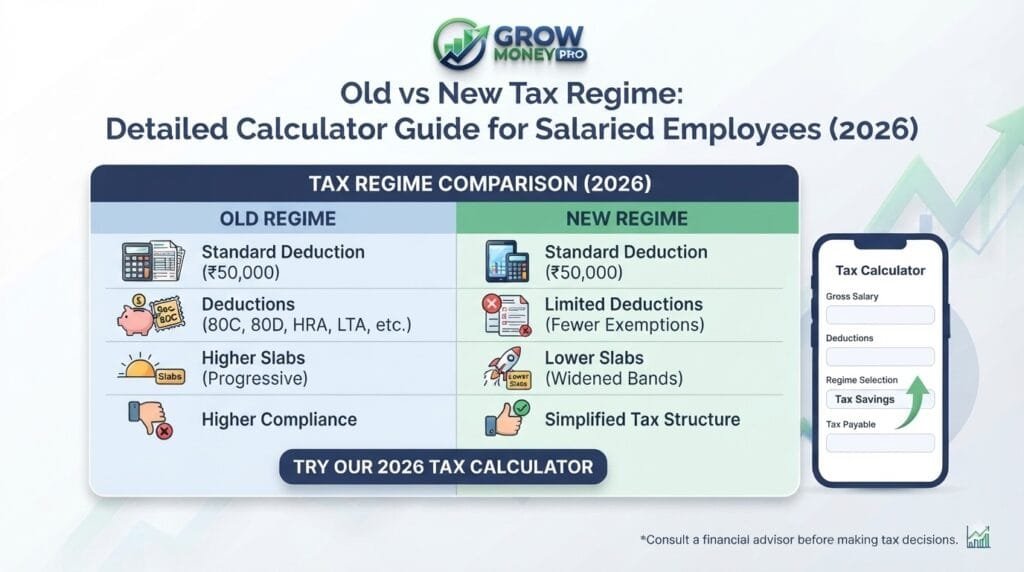
To understand which tax structure works best for your salary bracket under the Old vs New Tax Regime debate, you must first understand how each system operates fundamentally.
What is the Old Tax Regime?
The old tax regime is the traditional method of taxation in India. It functions as an incentive-based system where the government encourages you to save, invest, and secure your financial future.
- The Benefit of Deductions: You can substantially reduce your taxable income under the Old vs New Tax Regime framework by claiming a wide range of deductions and exemptions.
- Key Provisions: This includes Section 80C (PPF, ELSS, EPF, Life Insurance), Section 80D (Health Insurance premiums), House Rent Allowance (HRA), Leave Travel Concession (LTC), and Home Loan Interest deductions under Section 24.
- Standard Deduction: Salaried individuals and pensioners are eligible for a standard deduction of ₹75,000.
What is the New Tax Regime?
Introduced to simplify the tax structure, the new tax regime offers significantly lower tax slab rates and a wider zero-tax bracket, though it strips away almost all major exemptions and deductions.
- Default Status: As per current tax guidelines, the new regime under the Old vs New Tax Regime options is automatically selected on the e-filing portal unless you manually opt out.
- Zero Tax up to ₹12 Lakh: Thanks to revised slab rates and the enhanced Section 87A rebate, resident individuals with a taxable income of up to ₹12 lakh pay zero tax. For salaried individuals, factoring in the ₹75,000 standard deduction, an income up to ₹12.75 lakh effectively attracts zero tax.
- No Paperwork Hassles: You do not require investment proofs, rent receipts, or cumbersome physical documents to claim deductions.
Part 2: Comprehensive Tax Slab Comparison (2026)
Let us examine the exact tax slabs side by side to see how your income is taxed under both frameworks of the Old vs New Tax Regime.
| Taxable Income Slabs (Old Regime) | Tax Rate | Taxable Income Slabs (New Regime) | Tax Rate |
|---|---|---|---|
| Up to ₹2.5 Lakh | Nil | Up to ₹4 Lakh | Nil |
| ₹2.5 Lakh to ₹5 Lakh | 5% | ₹4 Lakh to ₹8 Lakh | 5% |
| ₹5 Lakh to ₹10 Lakh | 20% | ₹8 Lakh to ₹12 Lakh | 10% |
| Above ₹10 Lakh | 30% | ₹12 Lakh to ₹16 Lakh | 15% |
| – | – | ₹16 Lakh to ₹20 Lakh | 20% |
| – | – | ₹20 Lakh to ₹24 Lakh | 25% |
| – | – | Above ₹24 Lakh | 30% |
(Note: Surcharge, Health, and Education cess of 4% apply additionally based on total income slabs as per official guidelines provided by the Income Tax Department of India).
Part 3: Step-by-Step Tax Calculation Case Study
Numbers tell the real story. When analyzing the Old vs New Tax Regime, let’s evaluate a practical case study of a salaried professional earning a gross annual salary of ₹15,00,000.
Assumptions for the Case Study:
- Gross Salary: ₹15,00,000
- Standard Deduction: ₹75,000 (Applicable to both regimes)
- Old Regime Deductions Claimed by Employee:
- Section 80C (EPF + ELSS + PPF) = ₹1,50,000 (Maximum limit)
- Section 80D (Medical Insurance for family) = ₹25,000
- HRA Exemption (Actual rent paid calculation) = ₹1,50,000
- Total Deductions under Old Regime: ₹3,25,000
Calculation A: Under the Old Tax Regime
- Gross Salary: ₹15,00,000
- Less Standard Deduction: -₹75,000
- Less Total Deductions (80C + 80D + HRA): -₹3,25,000
- Net Taxable Income: ₹11,00,000 (15,00,000 – 75,000 – 3,25,000)
- Tax Computation Breakdown:
- Up to ₹2.5 Lakh: Nil
- ₹2.5 Lakh to ₹5 Lakh (at 5%): ₹12,500
- ₹5 Lakh to ₹10 Lakh (at 20%): ₹1,00,000
- ₹10 Lakh to ₹11 Lakh (at 30%): ₹30,000
- Total Tax Payable (Old Regime): ₹1,42,500 (plus applicable cess).
Calculation B: Under the New Tax Regime
- Gross Salary: ₹15,00,000
- Less Standard Deduction: -₹75,000
- Less Other Deductions: ₹0 (Not permitted under new rules)
- Net Taxable Income: ₹14,25,000 (15,00,000 – 75,000)
- Tax Computation Breakdown (New Slabs):
- Up to ₹4 Lakh: Nil
- ₹4 Lakh to ₹8 Lakh (at 5%): ₹20,000
- ₹8 Lakh to ₹12 Lakh (at 10%): ₹40,000
- ₹12 Lakh to ₹14.25 Lakh (at 15%): ₹33,750 (2,25,000 \times 15\%)
- Total Tax Payable (New Tax Regime): ₹93,750 (plus applicable cess).
The Verdict for this Case Study: Even after claiming ₹3.25 lakh in deductions under the old regime, evaluating the Old vs New Tax Regime shows that the New Tax Regime saves this employee over ₹48,000 due to its much lower slab rates and wider structural brackets!
Part 4: When Should You Choose Which Regime? (The Golden Rules)
To make an informed decision regarding the Old vs New Tax Regime for your own finances, evaluate your yearly commitments using these guidelines:
1. Opt for the New Tax Regime if:
- You have low or zero traditional investments: If your savings under 80C are minimal and you do not invest in market-linked tax savers like ELSS or PPF.
- You live in your own house: If you do not pay rent (hence no HRA benefit) and do not have an active housing loan running.
- Your income falls below ₹12.75 lakh: You enjoy complete tax exemption without submitting physical investment proofs or keeping cumbersome records.
- For broader macroeconomic context regarding how government policies and fiscal updates shape personal taxation under the Old vs New Tax Regime, you can review policy updates published by the Reserve Bank of India (RBI).
2. Opt for the Old Tax Regime if:
- You have heavy deductions: If your combined deductions under Section 80C, 80D, HRA, and Home Loan interest (Section 24) comfortably exceed ₹2.5 lakh to ₹3 lakh per year.
- You are paying a large home loan: If you live in a rented house while paying off a home loan for a property, you can claim both HRA and home loan interest simultaneously under the old rules, making it vastly superior for high-debt profiles.
Frequently Asked Questions (FAQ)
1. Can salaried employees switch between the old and new tax regimes every year? Yes! Salaried and pensioned individuals who do not have business or professional income possess the flexibility to choose either the Old vs New Tax Regime every single financial year when filing their ITR.
2. Is the standard deduction applicable under both systems? Yes, a uniform standard deduction of ₹75,000 is available to salaried employees and pensioners under both systems of the Old vs New Tax Regime.
3. Which tax regime is selected by default on the portal? The New Tax Regime is the default option when you log into the Income Tax e-filing portal. If you want to use the old regime, you must explicitly select it during your ITR submission process.
Check out live updates and financial indices on Moneycontrol